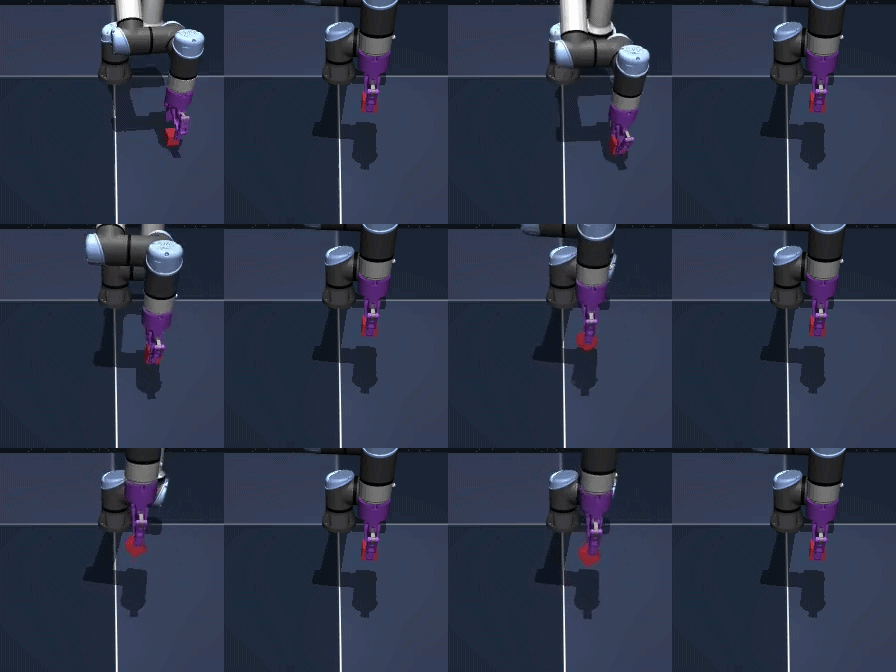
AMI's world-model thesis and the search for external validation
Researcher Randall Balestriero took the JEPA framework to Harvard, arguing publicly that the field needs more mathematical rigor to advance world models.
Balestriero at Harvard: AMI is actively evangelizing JEPA theory, not just building it
researchBrown University's Randall Balestriero's post on 11 September announcing a Harvard talk on "world models, the Le* family and why we need more theory and mathematics to advance JEPAs" is a compact statement of AMI's current intellectual stance. The framing—that the community needs more rigorous theory—is a positioning move as much as a research claim: it implicitly critiques the empirical-first, scale-first approach that dominates the LLM mainstream and reasserts the JEPA program as a principled alternative.
This public advocacy role for Balestriero complements what the GitHub record shows: Quentin Le Lidec reviewed a pull request in the `galilai-group/stable-worldmodel` repository this week, suggesting active engineering work on world-model infrastructure is running in parallel with the theoretical outreach. The combination — a researcher on stage arguing for the mathematical foundations of JEPAs while an engineer reviews world-model code — points to a team that is simultaneously building and recruiting intellectual consensus around its approach.
Mistral AI, AMI Labs… L'appétit grandissant de Samsung pour la French Tech
What is AMI Labs?
Advanced Machine Intelligence is one of the most closely watched AI startups in the world. Founded in 2025 by Yann LeCun and Alexandre LeBrun, it's building AI systems that reason about the physical world, not just language.
About the company →What are World Models?
World Models are AI systems that learn an internal representation of how the world works — enabling machines to plan, predict, and reason about physical reality the way humans do.
The science →The Team
AMI Labs has assembled researchers, engineers, and operators across Paris, New York, Montreal, and Singapore. We track every key hire and leadership change as the team grows.
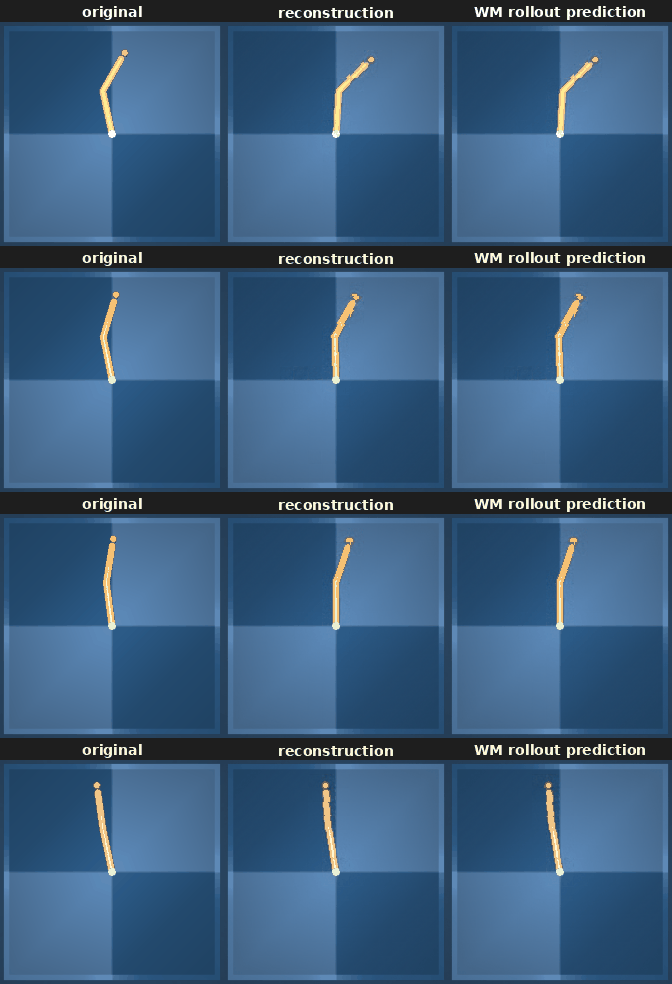
Meet the team →How a world model sees the future
Given what it observes, the model reconstructs the present and rolls out what happens next — a prediction of physics, not a retrieval of text. Below: a reacher arm, its reconstruction, and the model's forecast, side by side.
Global hiring accelerates
AMI Labs begins scaling its team across Paris, New York, Montreal, and Singapore — recruiting world-class researchers, engineers, and operators to build World Models.
$1.03B seed round at $3.5B valuation
AMI Labs closes a landmark $1.03 billion seed round — one of the largest in AI history — backed by Jeff Bezos, Bezos Expeditions, NVIDIA, Samsung, Eric Schmidt, and 60+ investors.
Yann LeCun joins as Executive Chairman
Turing Award laureate and former Meta Chief AI Scientist Yann LeCun co-founds AMI Labs, bringing his vision for World Models and next-generation machine intelligence.
AMI Labs brand launched
PengyouCo rebrands as Advanced Machine Intelligence (AMI Labs), unveiling its mission to build AI systems that go beyond language — grounded in the physical world.
Corporate structure formalised
Articles of association updated with early share restructuring: 1,000,000 shares divided into ordinary shares and SP preference shares carrying 10× voting rights.
Every Monday, The French Tech Journal sends a digest of the latest AMI Labs news — funding, research, hiring, and more. Independent coverage. No spin.
Stay updated
Weekly digest of new news, jobs & updates from AMI Labs.