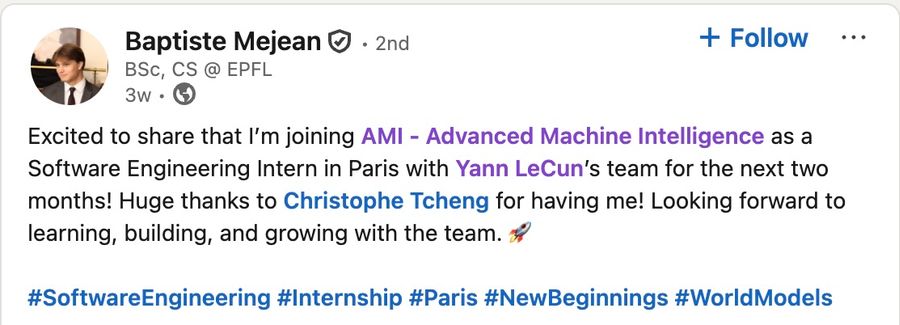
AMI Labs has quietly assembled a small but technically ambitious group of interns across its Paris and New York operations. The cohort includes one undergraduate software engineer and three New York University researchers working in areas closely aligned with AMI’s central mission: world models, video understanding, generative modeling, robot perception and planning. Rather than operating as a separate student program, the internships appear to place participants directly inside research teams led by figures including Yann LeCun, Saining Xie and Michael Rabbat.
The “intern” label also covers markedly different levels of seniority. Baptiste Mejean is completing a short undergraduate engineering placement, while Ying Wang, Nanye Ma and Raktim Gautam Goswami are doctoral researchers who entered AMI with established publication records and prior experience at laboratories including Meta FAIR, Google and NVIDIA. In Wang’s case especially, the public evidence suggests something closer to an ongoing research collaboration conducted under an internship title than a conventional summer placement.
Ying Wang joined AMI as a research intern in May 2026 while pursuing a PhD in data science at NYU’s CILVR lab. She previously worked as a research scientist intern at Meta and as a software engineer at Amazon, and her research focuses on reasoning, planning and multimodal learning. Her role appears particularly substantive: Wang already works with NYU professors Mengye Ren and Yann LeCun and is the lead author of Temporal Straightening for Latent Planning, accepted at ICML 2026, and AdaJEPA, a new adaptive latent-world-model paper co-authored with LeCun and Oumayma Bounou. She also co-authored an earlier visual-question-answering paper with LeCun. The public record does not prove that all of this work was produced at AMI, but it suggests that her internship extends an established research collaboration rather than beginning one from scratch.
Nanye Ma is an NYU computer-science PhD student who joined AMI’s New York team as a research intern in May. He previously spent eight months as a research intern at NVIDIA and a year as a student researcher at Google, after completing an NYU bachelor’s degree in mathematics and computer science. Ma’s work spans diffusion and flow-based generative models, including research on scalable interpolant transformers and inference-time scaling. He was also a project lead and equal technical contributor on VSTAT, a 2026 benchmark developed with Saining Xie that tests whether multimodal models can continuously track changing objects and events through video.
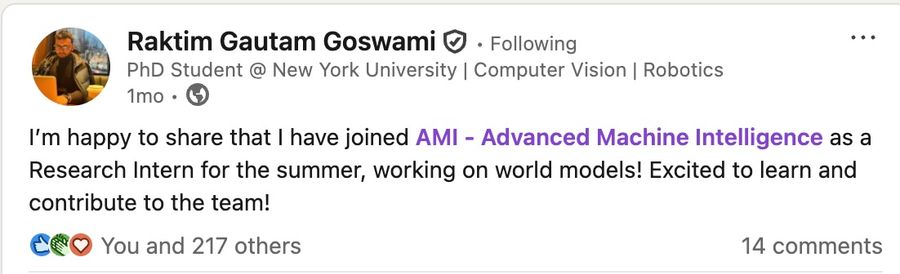
Raktim Gautam Goswami joined AMI as a summer research intern working on world models under Yann LeCun and Michael Rabbat. He is completing a PhD in electrical engineering at NYU Tandon, where his research combines computer vision, robot perception, visual navigation, pose estimation and control. Goswami previously spent nine months at Meta FAIR working with LeCun on world models for dexterous manipulation. His research includes DexWM, which learns fine-grained hand-object interactions from more than 900 hours of human and robot video, and WorldDP, a framework combining object-centric world models with diffusion policies for multistage robotic tasks. His existing collaborations with numerous AMI researchers make the internship another example of the laboratory absorbing researchers already working inside its intellectual network.
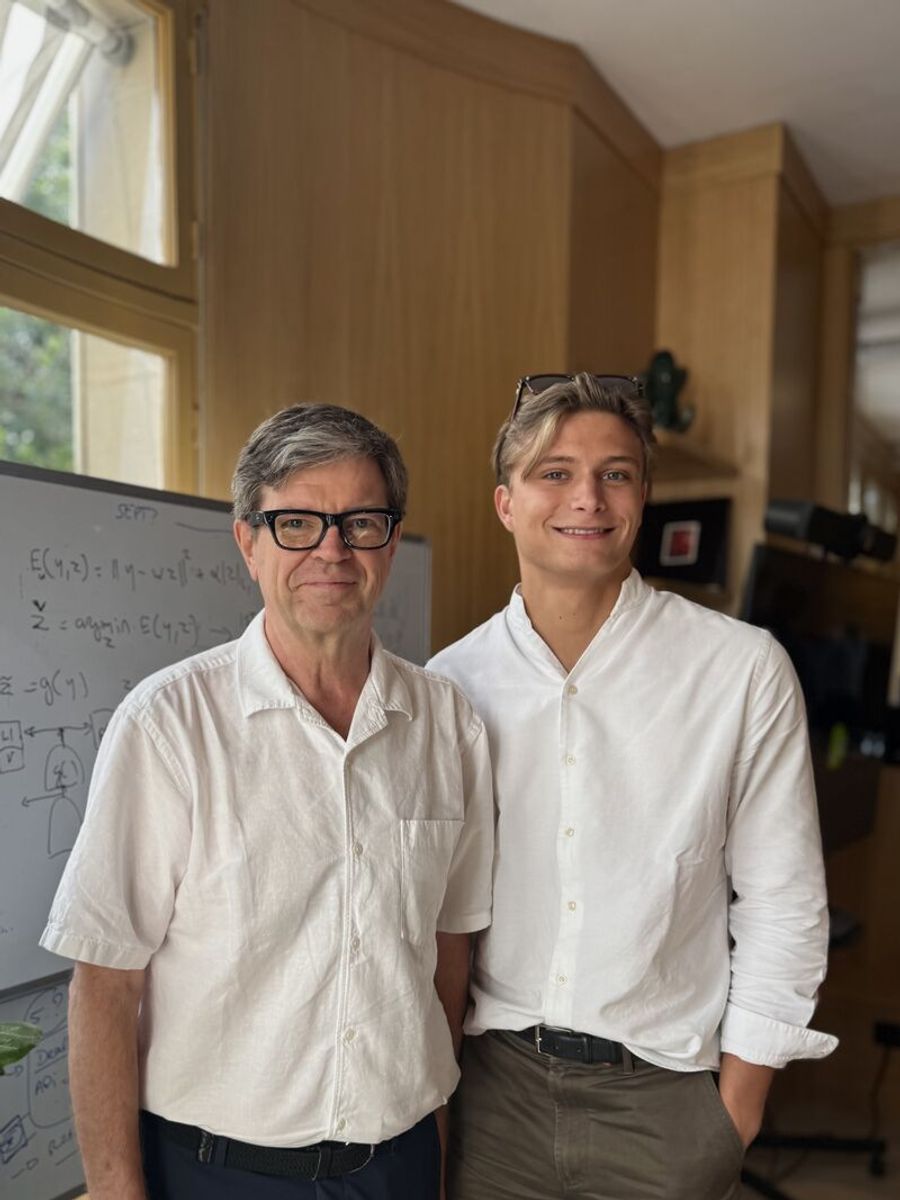
Baptiste Mejean represents the cohort’s more conventional software-engineering track. The EPFL undergraduate joined AMI’s Paris office in July for a two-month software-engineering internship with LeCun’s team. He is studying computer science and communication systems and has served as an EPFL teaching assistant for an advanced information, computation and communication course. Mejean also founded Goodminds and previously completed an internship at French health-tech company Nabla. His appointment suggests AMI is complementing its PhD-heavy research pipeline with younger engineering talent capable of helping turn experimental world-model research into functioning systems.
Taken together, the four profiles show that AMI is using internships both as a traditional training route and as a flexible mechanism for bringing established academic collaborators into the lab. The result is a cohort that ranges from an undergraduate engineering placement to doctoral researchers already publishing alongside AMI’s senior scientists—and, in some cases, contributing to the research agenda before their internships formally began.