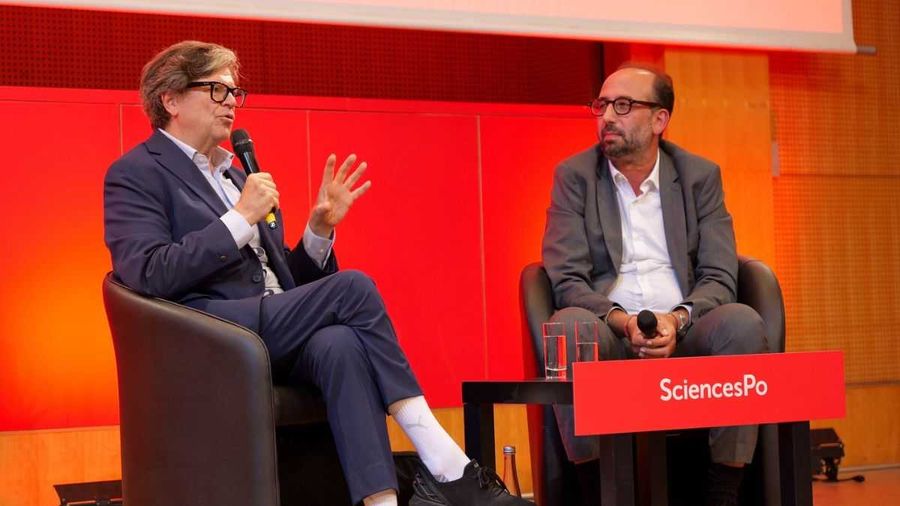
Yann LeCun has little patience for an AI timeout. At Sciences Po, the Turing laureate argued that calls to slow development risk handing more power to the companies already dominating the industry.
Speaking on September 16 with moderator Éric Hazan, AMI Labs’ executive chairman delivered a combative defense of continued research, open models, and Europe’s chances of shaping what comes next. His confidence extended from humanity’s ability to control smarter machines to France’s suitability for hosting data centers.
His sharpest criticism targeted Anthropic’s Dario Amodei. LeCun accused advocates of a pause of wrapping commercial interests in ethical language, arguing that warnings about existential dangers could encourage governments to restrict open models and protect incumbents.
LeCun’s preferred approach is to regulate deployment. Driving assistance should undergo independent reliability testing; medical imaging systems should demonstrate benefits before entering clinical use. He argued that existing sectoral rules already address many such questions, while restrictions on research would anticipate technologies that have yet to be invented.
He acknowledged genuine ethical issues but rejected the premise that today’s powerful AI systems are intrinsically dangerous. Asked about catastrophic cyberattacks and engineered pathogens, he dismissed several scenarios as material for a “James Bond” film. He argued that AI also strengthens cyberdefenses and that biological attacks face formidable practical obstacles.
His optimism reaches beyond current systems. Machines will eventually surpass human intelligence, he predicted, but humans would still choose their goals. He compared that relationship to directing exceptionally capable colleagues: their intelligence could amplify human agency rather than automatically displace it.
On infrastructure, LeCun made a pointed case for France. Its largely low-carbon electricity supply, he argued, makes it an attractive location for data centers. Yet he acknowledged a domestic trade-off: additional demand would probably push electricity prices upward, even if the associated carbon footprint remained relatively limited.
He also argued that energy costs already give technology companies strong incentives to improve efficiency through better chips, algorithms, and model designs. In his view, those commercial pressures weaken the case for additional regulation aimed specifically at reducing AI’s energy consumption.
His dismissal of water concerns was more sweeping. LeCun claimed data centers do not consume water because they recycle it in closed circuits. That generalization does not hold across the industry: evaporative cooling consumes water, while some newer designs avoid evaporation by recirculating water. The environmental impact depends on the cooling system employed.
Europe’s opportunity, meanwhile, lies in another technological shift. LeCun argued that language models’ fluency masks their limited grasp of physical reality. AMI is pursuing world models that predict the consequences of actions, supporting planning and robotics. He said the models AMI trains are smaller and require less memory than LLMs, potentially lowering the infrastructure barrier. The company, he noted, still has no revenue and is spending heavily on computing.
On robotics, he was less bullish: household machines capable of clearing tables remain some way off, despite the spectacle of humanoids performing acrobatics.
He was concerned about dependence on proprietary assistants from a handful of American or Chinese companies. If those systems mediate access to information, he warned, cultural diversity and democratic autonomy are at stake.
“Sovereignty is not optional,” LeCun insisted. He promoted Project Tapestry, an international effort to develop open AI incorporating languages and cultural knowledge beyond today’s dominant datasets. He said governments including India, Japan, and Vietnam supported the initiative, with European backing still being sought.
For LeCun, the immediate political challenge is who gets to build AI and whose knowledge it reflects. His prescription was continued experimentation, wider participation, and scrutiny of actual applications. Europe, he insisted, could help build that next generation.