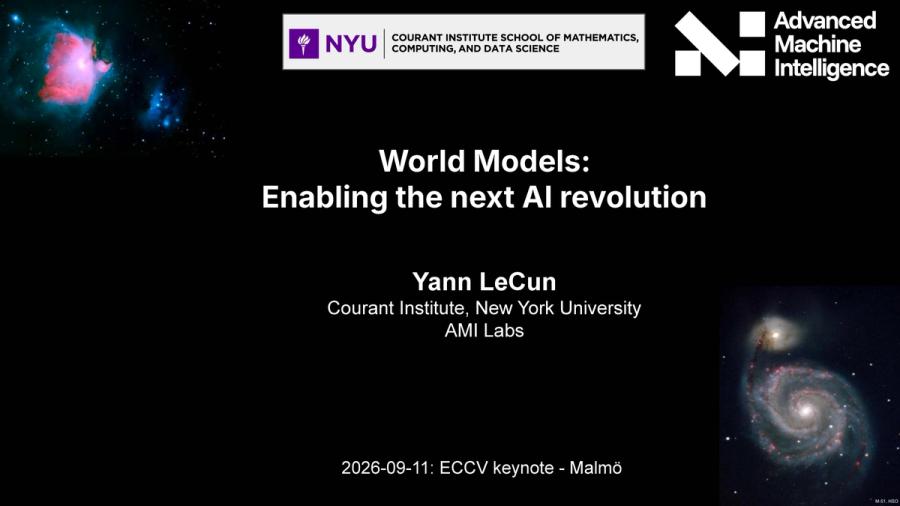
Yann LeCun brought more evidence to his latest pitch for world models: a mathematical argument about what they learn, and medical studies showing what that learning might be good for.
His September 11 keynote at the European Conference on Computer Vision in Malmö elaborated on the scientific foundations behind AMI Labs. For anyone tracking the company, the additions offer a useful progress report, although its commercial destination remains largely unchanged.
A comparison with LeCun’s April 14 presentation makes that continuity clear. AMI’s ambitions across healthcare, manufacturing, aerospace, defense, and finance were already explicit. So were the examples of aircraft generating vast quantities of sensor data, and the prospect of eventually modeling cells, organs, and bodies. Those ideas should not be mistaken for newly disclosed expansion plans.
The more consequential addition concerns whether world models learn representations that capture how their environment works.
LeCun highlighted When Does LeJEPA Learn a World Model?, a May paper co-authored with David Klindt and Randall Balestriero. It addresses a fundamental problem: compressing observations into mathematical representations helps planning only if those representations preserve the world’s underlying structure.
The researchers establish conditions under which LeJEPA can recover underlying variables from nonlinear observations, up to a linear transformation. They also connect that recovery to planning. The guarantees depend on specific assumptions about how those variables are distributed and evolve, including Gaussian distributions. This supplies theoretical support for the approach, without proving that it will uncover the workings of every complex system.
The medical additions bring that broader ambition into sharper focus.
One slide features LeDXA, an August preprint co-authored by LeCun and Balestriero. The model learns from whole-body scans normally used to measure bone density and body composition. The study reports that the resulting representations contain information useful for predicting disease risk and biological aging, with evaluation on a separate UK Biobank dataset.
For AMI watchers, the significance is practical: this is evidence that JEPA can extract useful information from specialized medical imagery. It does not demonstrate a complete medical agent capable of planning treatment, or establish a commercial deployment by AMI.
Another addition showcases RayDINO research on X-ray analysis. Here, the novelty needs particular care: the study already had a 2024 preprint. Its inclusion adds another medical example to the presentation, rather than introducing a new capability.
LeCun also spends more time explaining the machinery underneath these systems: search, optimization, energy-based models, and methods for preventing representation collapse, where different inputs become indistinguishable inside the model. That expanded treatment makes the training argument more detailed, while retaining his established commitment to prediction in abstract representations and planning through world models.
The additions strengthen the scientific case LeCun is assembling around AMI’s research direction. They show where theory is becoming more precise and where applications are producing concrete results. The slides disclose no new product, customer, partnership, or launch timetable. For now, the evidence is accumulating around the company’s ambitions, while the shape of its eventual commercial offering remains open.