World models may be one of AI’s hottest research frontiers, but building them still involves a surprising amount of reinventing the wheel.
A new open-source platform called stable-worldmodel is trying to change that. Co-created by Lucas Maes and Quentin Le Lidec, it bundles the messy plumbing of world-model research into one shared framework by collecting data, training models, planning actions and evaluating results.
For AMI watchers, the connection is unusually direct. Le Lidec, the paper’s co-lead author, recently joined AMI as a postdoctoral researcher working on world models for robotics. Maes and Le Lidec were co-lead authors on LeWorldModel released earlier this year, and considered a breakthrough in how simply world models can be built. (See Explainer here)
AMI co-founder Yann LeCun is also credited among the authors and collaborators.
Instead of every paper arriving with its own codebase, slightly different planner and bespoke benchmark, researchers can test ideas on common foundations and make something closer to apples-to-apples comparisons.
That matters because world models are supposed to give AI something closer to an internal simulator. Rather than simply generating plausible words, they learn how an environment changes: what happens when an object moves, an action is taken or physical conditions shift.
An agent can use that model to “imagine” possible futures, select an action and replan — a crucial step toward machines that can reason and operate in the physical world. Yet the paper says progress has been slowed by fragile one-off implementations, sluggish video loading and the lack of standardized tests for generalization.
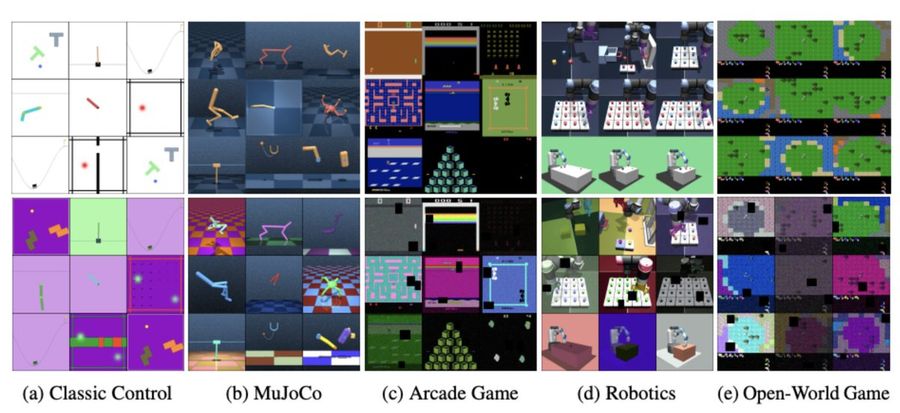
Stable-worldmodel does not propose a single new brain. Think of it as a better laboratory bench. The platform is organized around three components: a “World” containing simulated environments, a “Policy” that chooses actions and a “Solver” that plans them. It ships with reference versions of models including DINO-WM, LeWorldModel, PLDM and TD-MPC2, plus planners such as CEM, MPPI and gradient-based methods. Researchers can run them across roughly 150 environments spanning games, control and robotics, then alter colors, shapes, lighting, gravity, friction and other variables to see whether a model has learned real dynamics or merely memorized familiar scenery.
There is also a less glamorous but important engineering advance. World-model training depends heavily on video and multimodal trajectories, which can leave expensive GPUs waiting around for data. Built around Lance’s machine-learning-optimized data format, stable-worldmodel can use the same loading path for local storage, cloud object stores or Hugging Face buckets. In the paper’s Push-T benchmark, Lance processed 4,815 samples per second locally, compared with 1,416 for HDF5 and 1,331 for video, while still offering a practical storage trade-off.
The first experiments also deliver a useful reality check. Current models remain brittle: modest changes in color, size or visual clutter can send planning success tumbling. Just as strikingly, low prediction error does not reliably mean an agent will choose the right actions. Stable-worldmodel does not solve those weaknesses; it makes them easier to expose, reproduce and attack.
That makes stable-worldmodel infrastructure for the broader scientific program AMI is betting on: taking world models from elegant demonstrations toward robust systems that can plan in unfamiliar environments. Before the field can scale, it needs common ground. This platform is an attempt to build it.