- Yann LeCun — Co-author
Patch Policy provides evidence that high-performance embodied intelligence may emerge from modular systems that combine powerful pretrained representations with small, specialized control policies.
The paper identifies a consequential architectural bottleneck in robot learning: most conventional policies compress an entire image into one global vector, discarding the precise spatial relationships needed for manipulation, while vision-language-action models preserve richer visual information only by carrying the computational burden of billion-parameter language-model backbones.
Patch Policy proposes a third path. It passes the complete grid of localized features from a frozen, internet-pretrained Vision Transformer directly into a lightweight policy, using a block-causal attention mask that allows full spatial reasoning within each frame while preserving causality across time. In other words, it separates visual intelligence from language-model scale rather than assuming the two must remain bundled together.
Read a more detailed explainer here.
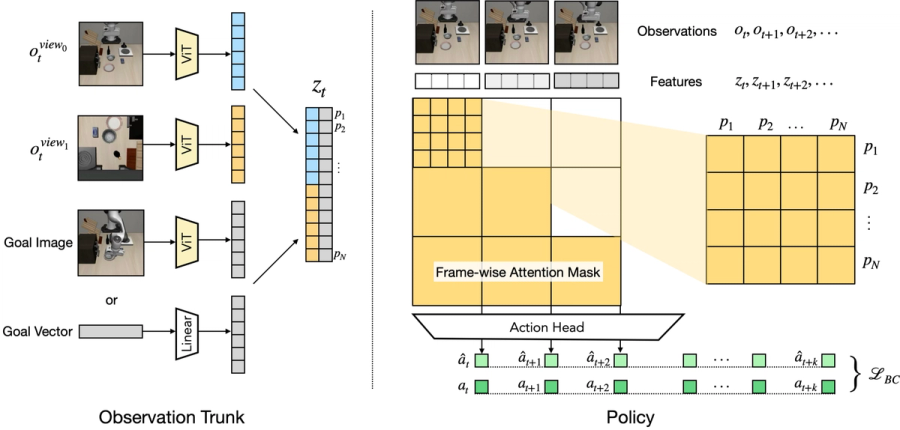
The results suggest that the quality and granularity of an agent’s internal representation may matter more than the sheer size of its policy model. Across four simulated environments, replacing globally pooled representations with dense patch features produced a reported 40% relative improvement. Patch Policy also surpassed the fine-tuned OpenVLA-OFT baseline by 18% while using roughly 0.7% of its parameters. Crucially, the gains were concentrated in spatially demanding and multi-object tasks such as BlockPush and Cube, while progressively compressing the patch grid degraded performance. This supports a broader AMI Observatory thesis: intelligence failures can result from representational bottlenecks, not merely insufficient model capacity.
The real-robot experiments make the finding especially significant. Patch Policy outperformed the evaluated baselines on cable insertion, pen collection, and tool hanging, with its clearest advantage appearing in cable insertion, where the final tolerance was approximately two millimetres. These are tasks in which success depends on continuously localizing small objects, estimating their relationships and correcting motion after contact—not simply recognizing the task or producing a high-level plan. OpenVLA-OFT frequently reached the vicinity of the socket but failed during fine-grained closed-loop control, suggesting that semantic understanding and physical control remain distinct capabilities. Dense visual representations appear to supply the geometric detail required to bridge that gap.
The paper also changes the economic discussion around embodied AI. The DINOv2-based VQ-BeT configuration contains approximately 52 million total parameters and runs at about 11 milliseconds per inference step in the paper’s H200 evaluation, compared with 7.61 billion parameters and roughly 62 milliseconds for OpenVLA-OFT. Because the visual encoder is frozen, its features can also be precomputed during training; the authors report 6.5 GPU-hours for the DINOv2 Patch Policy configuration, versus 16 GPU-hours for OpenVLA-OFT and 24 for ACT. The accompanying LinkedIn post extends this accessibility argument by stating that the system can be trained on a single RTX 5090. Together, these claims point toward a much lower capital threshold for developing fast, task-specific robot intelligence.
The deeper implication is that embodied AI may evolve as a modular stack rather than a single universal model: large-scale representation learning supplies reusable perceptual primitives, lightweight policies convert those primitives into rapid actions, and language or deliberative reasoning can be introduced only where the task requires it.
Patch Policy does not prove that large VLAs are unnecessary. The study is primarily based on behavior cloning, frozen visual backbones, and a bounded set of manipulation tasks.
But it does weaken the assumption that large language model scale is the primary driver of their performance. It therefore offers an important signal about where value may migrate in robotics: away from monolithic parameter counts and toward better representations, architectural interfaces, specialized policy heads and efficient real-time control.